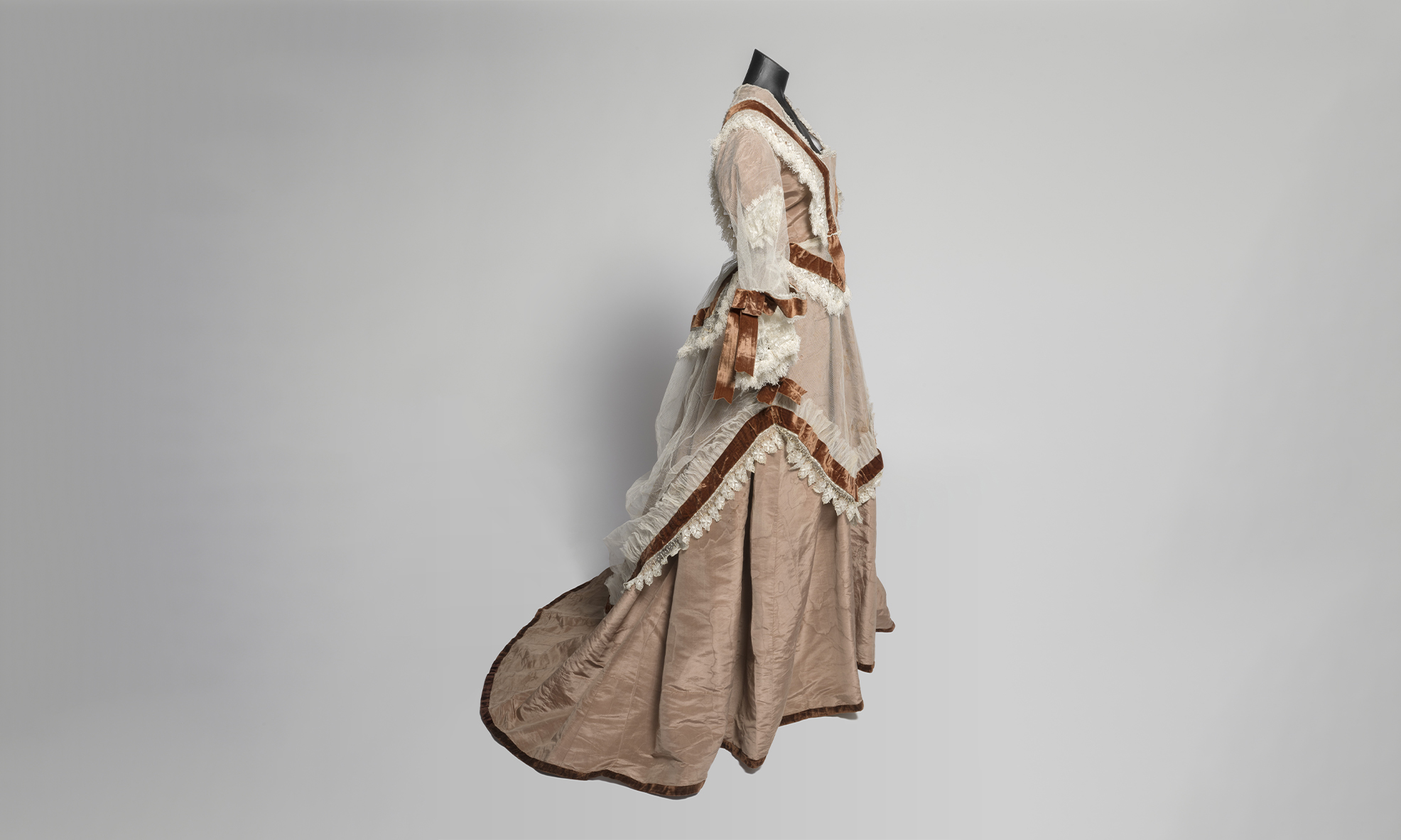
Mary De Salis’s wedding dress, c. 1878. Original moiré (watered) brown silk skirt and bodice with 20th century lace and velvet additions. Photo: Brenton McGeachie, 2025.
By Nicole Sutherland, Curator of Visual Arts and Social History at CMAG
This Mother’s Day, we’re highlighting the story of Mary de Salis (née Smith) of Cuppacumbalong, whose wedding dress was gifted to CMAG by her descendent Heather de Salis in 2017. Mary St Lawrence Irving Galliard Smith was the third child of Emily Smith (née Davies) and the Reverend Pierce Galliard Smith, rector of St John’s Church from 1855-1905. In 1878, she married George Fane de Salis, the third son of Charlotte and Leopold Fane de Salis of Cuppacumbalong. Mary’s wedding dress, made from brown moiré (watered) silk with lace and velvet additions is unique as the only wedding dress of the late nineteenth century in the CMAG collection. It offers a window into the lives of one of the first, more affluent settler families in the Canberra region, and especially the lives of the women and mothers who built homes and communities here.
Selecting the dress
When we began preparations to display the wedding dress of Mary de Salis in our permanent exhibition Canberra/Kamberri: Place and People, we could not have anticipated the discoveries we would make about the dress and the connections to the wider Canberra community that would emerge. Many hours were spent talking with conservators, historians, and De Salis family members; more were spent looking through vast archives and transcribing family letters. Still, we have much to learn about the dress.
The project began in 2024 with plans to refresh objects in our exhibition Canberra/Kamberri: Place and People. The exhibition opened in 2023 as CMAG’s first permanent display on the history and visual arts that have shaped the Canberra region. Although a ‘permanent’ exhibition, many of the more vulnerable objects on display – such as watercolour paintings, textiles, photographs and paper – cannot remain in the gallery for long periods due to their sensitivity to light. They need to be replaced with other collection objects, ideally 6-12 months after they first go on display.
Mary’s dress was chosen to replace the riding habit of Edith Lavinia Cameron in the first room of the exhibition, which explores the lives of some of the early colonial families on the Limestone Plains. We chose Mary’s wedding dress not only because it represented the period of early colonial occupation in the region, but also for its significance as a rare surviving example of an 1870s Canberra-region wedding dress.
Uncovering a Canberra love story
In July and August of 2025, I spent time at the National Library of Australia reading a small handful (only 40 or so!) of Mary’s letters from the extensive De Salis family manuscript collection. It was a joy to later transcribe, from her cursive script, Mary’s correspondence from 1877 and 1878 and especially to read of her excitement for her wedding in February 1878. Mary’s letters quickly revealed a picture of a young woman very much in love. In the months leading up to their wedding, Mary wrote to George:
‘You talk of me being the best girl in your opinion for hundreds of miles! Allow me to say that I am more happy still, for without in the least meriting it I have the love of the best boy for thousands of miles, the best in the wide world to me.’
In the sparsely populated settler community of the Limestone Plains, Mary Smith and George de Salis would have met one another at church or family gatherings with their neighbours. Mary’s letters highlight a web of connections with other families in the region, including the Thomases (Mesac Thomas was Lord Bishop of Goulburn), the Davises of Palmerville Estate (Ginninderra), the Campbells of Duntroon, the Crace and Mort families of Gungahleen (Gungahlin Homestead), and the Cunninghams of Lanyon. They also hint at tensions within the community, with Mary expressing relief that Sarah Cunningham of Lanyon would not be one of her bridesmaids, writing to George that ‘it is better pleasing to you that Sarah is not going to be one’.
In the month before her wedding, Mary and her mother spent several weeks in Sydney shopping for her wedding trousseau (clothes, linen and other items for married life) and dresses for her bridesmaids. Her letters to George in January 1878 expressed her excited anticipation for the wedding:
‘It does seem a strange idea that Mother and I should be on this trip for the purpose of getting a trousseau !!! and above all that it should be mine! And yet the time is drawing near for leaving my present house … Though I am miles further away yet this happiness is still with me knowing that you love me and that my heart’s best love is yours, how can I help being happy.’
In Sydney in February, she continued,
‘Today has been spent at the shops, ordering certain dresses for the brides & bridesmaids!! and getting among other things a bonnet! for this child! The first she has ever had!! I wonder if someone will approve of her in it, he is the cause of it being got for her, & very funny it will seem wearing one for the first time. Lizzie Campbell gave me a very pretty wedding present to-day, it is a silver jam glass.’
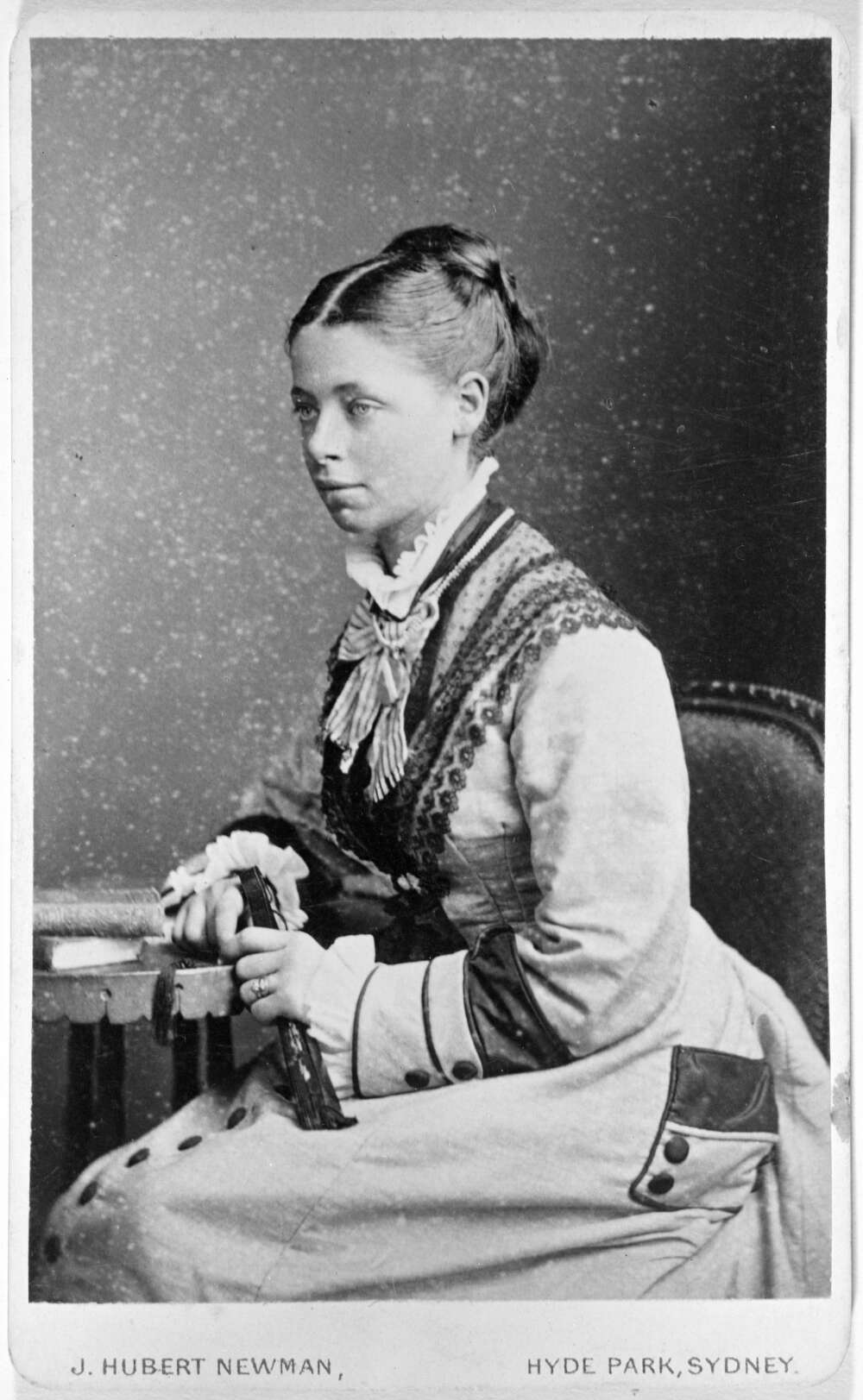
‘Portrait of Mary de Salis, ca. 1880 [picture] / J. Hubert Newman’. From the National Library of Australia collection, https://nla.gov.au/nla.obj-15112456. This photo may have been taken just prior to Mary and George’s wedding – Mary’s letter to George dated 7 Feb 1878 mentions a ‘Long walk to Newman’s [photographic studio] to see about photos … I hope you will like it’.
Mary’s letters to George are filled with the self-deprecating language of a young woman in love for the first time. She often referred to herself as ‘a stupid little mortal’ and ‘silly little girl’. It is clear, however, that George reciprocated Mary’s love as her letters reference his thoughtful gestures, such as keeping her love tokens to him – what she called ‘those withered violets’.
Mary and George married on the 28th of February 1878, nine days after Mary’s 21st birthday. They were wed at St John’s Church, now in the Canberra suburb of Reid, where Mary’s father, Pierce Galliard Smith, was the Reverend. However, on their wedding day, Mary and George were married by their close family friend, the Right Reverend Mesac Thomas, Lord Bishop of Goulburn.
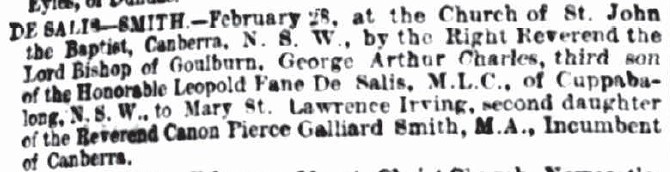
Mary and George’s wedding notice in the Sydney Morning Herald, 5 March 1878. https://trove.nla.gov.au/newspaper/article/13409066
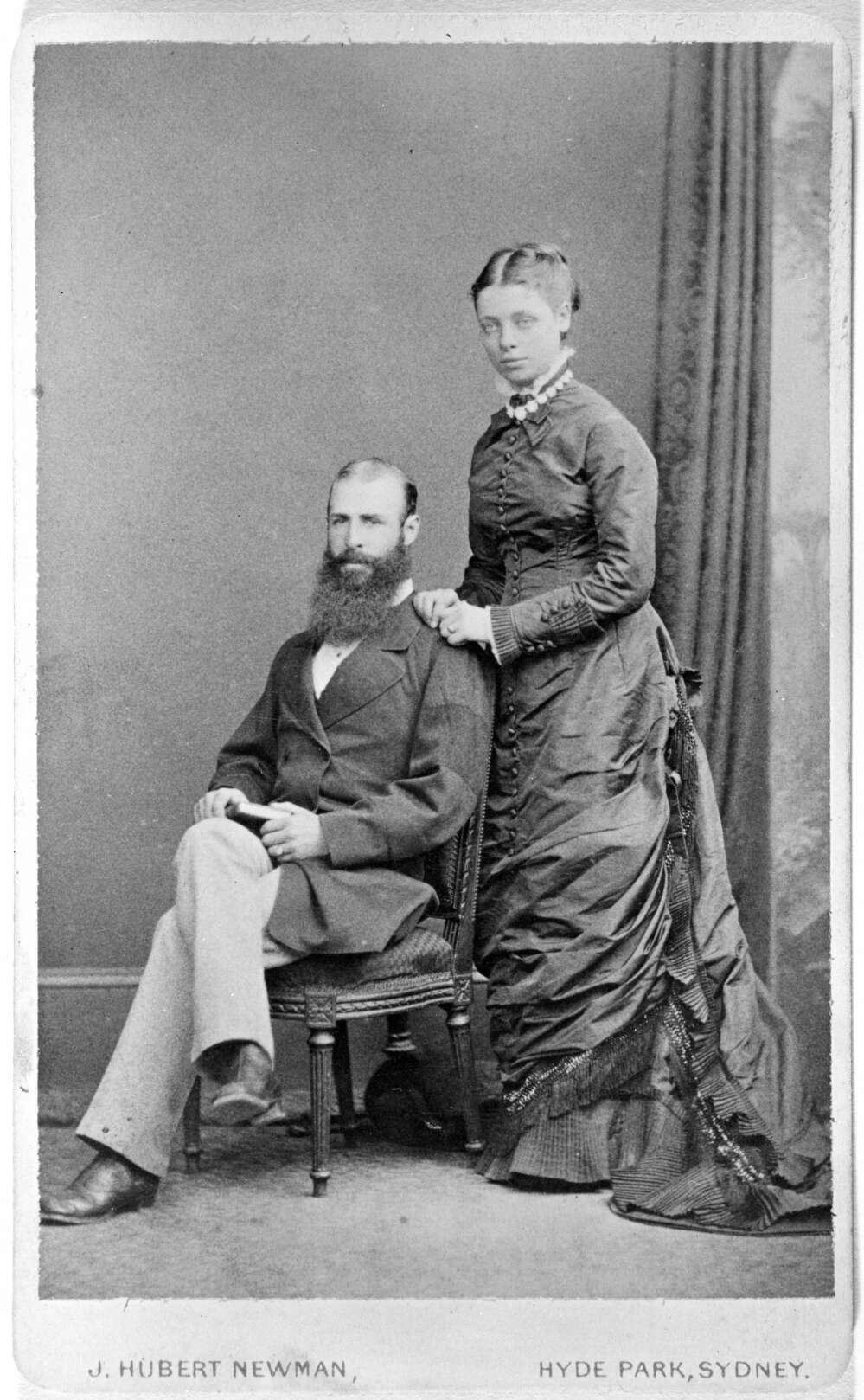
‘Portrait of George and Mary de Salis, ca. 1880 [picture]’, from the National Library of Australia collection. http://nla.gov.au/nla.obj-151124018
The De Salis family at Cuppacumbalong
After marrying, Mary moved in with George’s family at Cuppacumbalong. The De Salises purchased Cuppacumbalong in 1856 as a pastoral property, producing merino wool and draught horses. George ran livestock from Cuppacumbalong to land leased at Coolamon (now Coolamine), located in present-day Kosciusko National Park. He also had a brief stint in Parliament, representing Queanbeyan in the New South Wales Legislative Assembly from December 1882 to October 1885.
George was a warm-hearted husband who played pranks on his wife and was a keen reader, with interests in geology and astronomy. He kept sugar gliders as pets and taught his children, including his daughters, to hunt native wildlife. In his diaries, George remembered Mary as a wise counsellor and wonderful help to him, recounting fondly their engagement, early married life, and many horse rides and walks together around the region.
Mary and George had eight children at Cuppacumbalong: Arthur, Charlotte, Mary, Nina, Emily, Rodolph, George, and Charles Eric. The records of their first child Arthur are scarce as he died in infancy.
Mary’s letters mention George’s early hopes to create a home for the family at Naas, nestled among the hills of the Brindabella Range, but this never eventuated. After the loss of Cuppacumbalong during the economic downturn of the 1890s, the De Salises moved to Lambrigg with their Farrer relatives. In 1900, Mary and George bought their own land at Michelago, living in a former inn that they renamed ‘Soglio’. Mary died in 1927 and George died in 1931. They were married for 49 years.
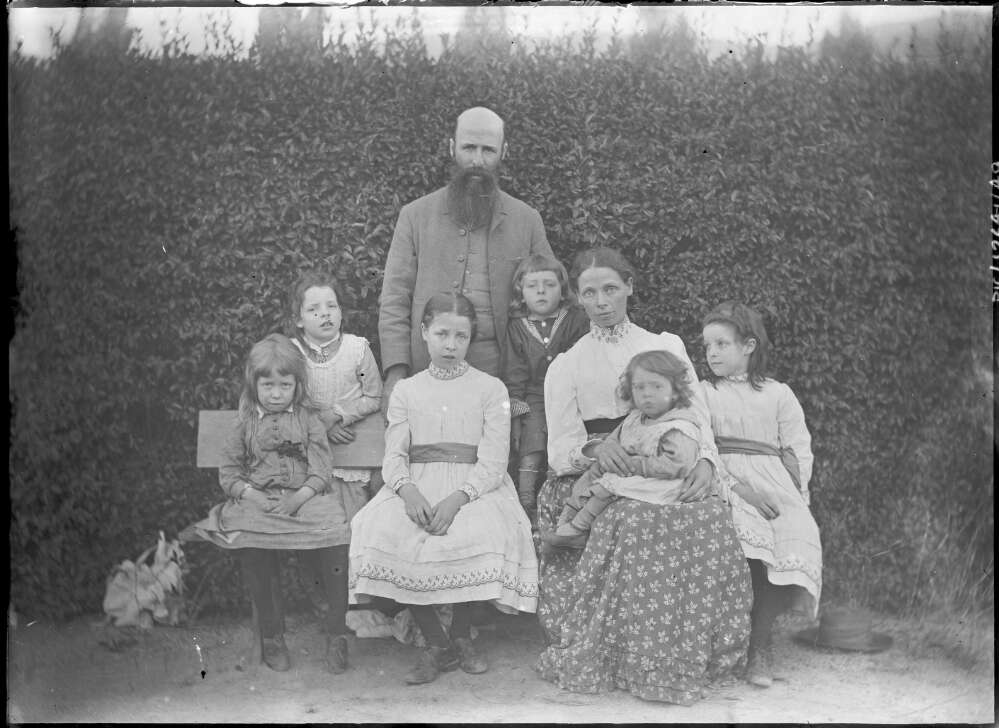
‘George and Mary De Salis, seated with children, Cuppacumbalong, Australian Capital Territory, ca. 1890 [picture]’. Back row: Nina, George (senior), Rodolph; Front row: Emily, Charlotte, Mary (senior) holding George (junior), Mary (junior). From the National Library of Australia collection, http://nla.gov.au/nla.obj-151607972
What the bride wore
Reading about Mary and George’s courtship and marriage was just one dimension of uncovering the story behind Mary’s dress.
Unfortunately for us, Mary’s self-proclaimed ‘prosy’ letters did not extend (as far as we have found) to a description of her wedding dress. Nor could we locate a photograph of her wearing it, despite our conversations with descendants from different arms of the extended De Salis families. As such, we have no knowledge of its original design and construction, which presented some challenges when preparing the unusual dress for display.
Mary’s wedding dress consists of two parts: a brown moiré (watered) silk skirt and a matching brown silk bodice lined with whale baleen (keratin from the jaw of the Baleen whale used in corset boning), to which a lace and velvet apron has been loosely attached.
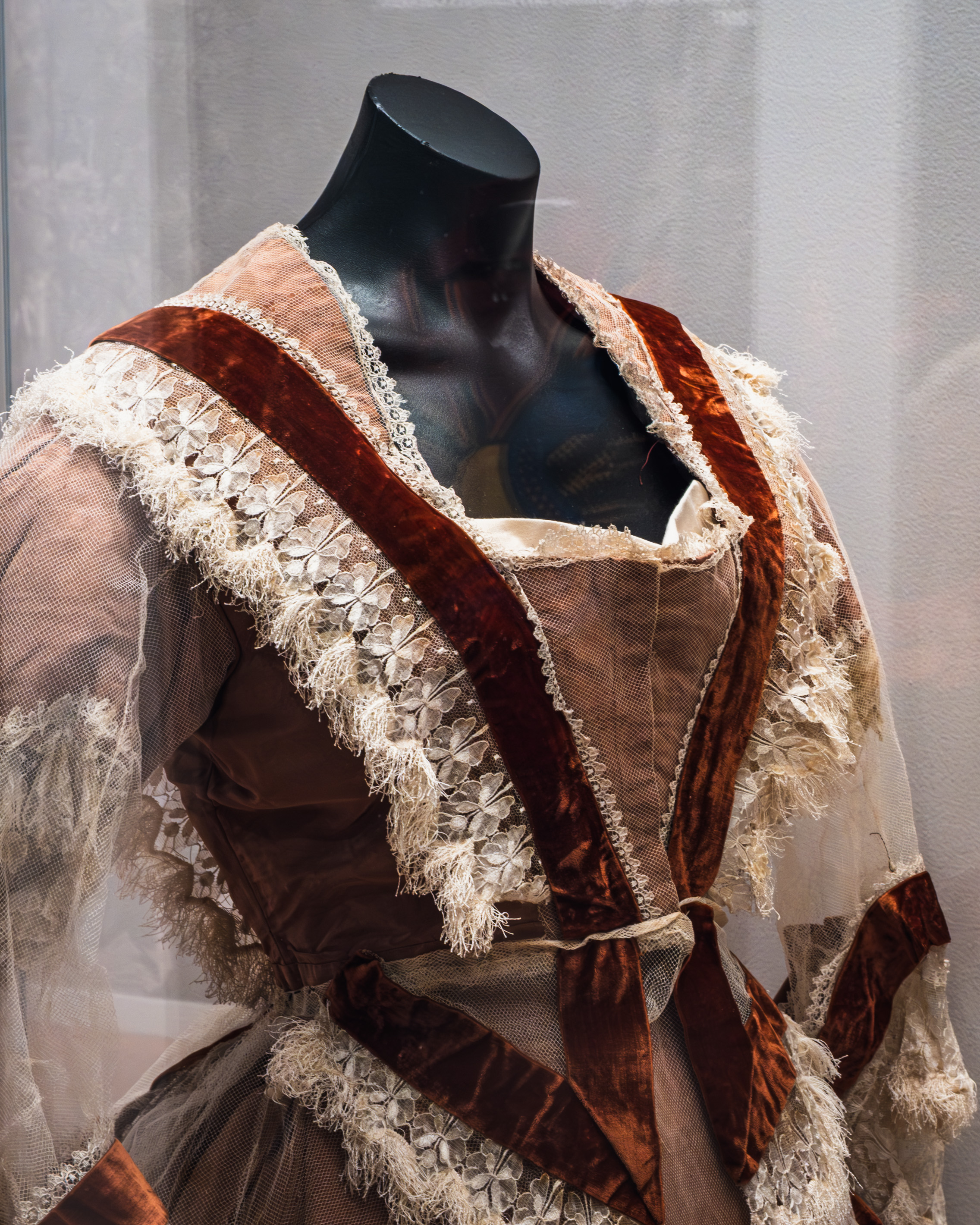
Pictured: the silk bodice of Mary’s dress, embellished with lace and velvet. Photo: Dominic Northcott, 2026.
To determine if Mary’s dress was in a stable enough condition for display, we took it to Endangered Heritage in Fyshwick for assessment, as well as conservation work on the lace apron and damaged waistband of the skirt. In our discussions with conservator Victoria Pearce, several things became apparent: firstly, that we knew very little about what sort of bustle or support would have been worn to hold up the voluminous skirts at the back of the ensemble (more on this later); and secondly, that some parts of the dress were not original to the 1870s garment.
The most surprising discovery from our visit to Endangered Heritage came from the fibre testing of the lace, which revealed that the lace and velvet apron was likely a twentieth century addition. The rayon lace post-dates the dress by at least thirty years in commercial use and the velvet trim on the hem – attached by a modern machine stitch – appears to be from the 1950s onwards, suggesting that the dress was altered after Mary’s time, perhaps for a costume.
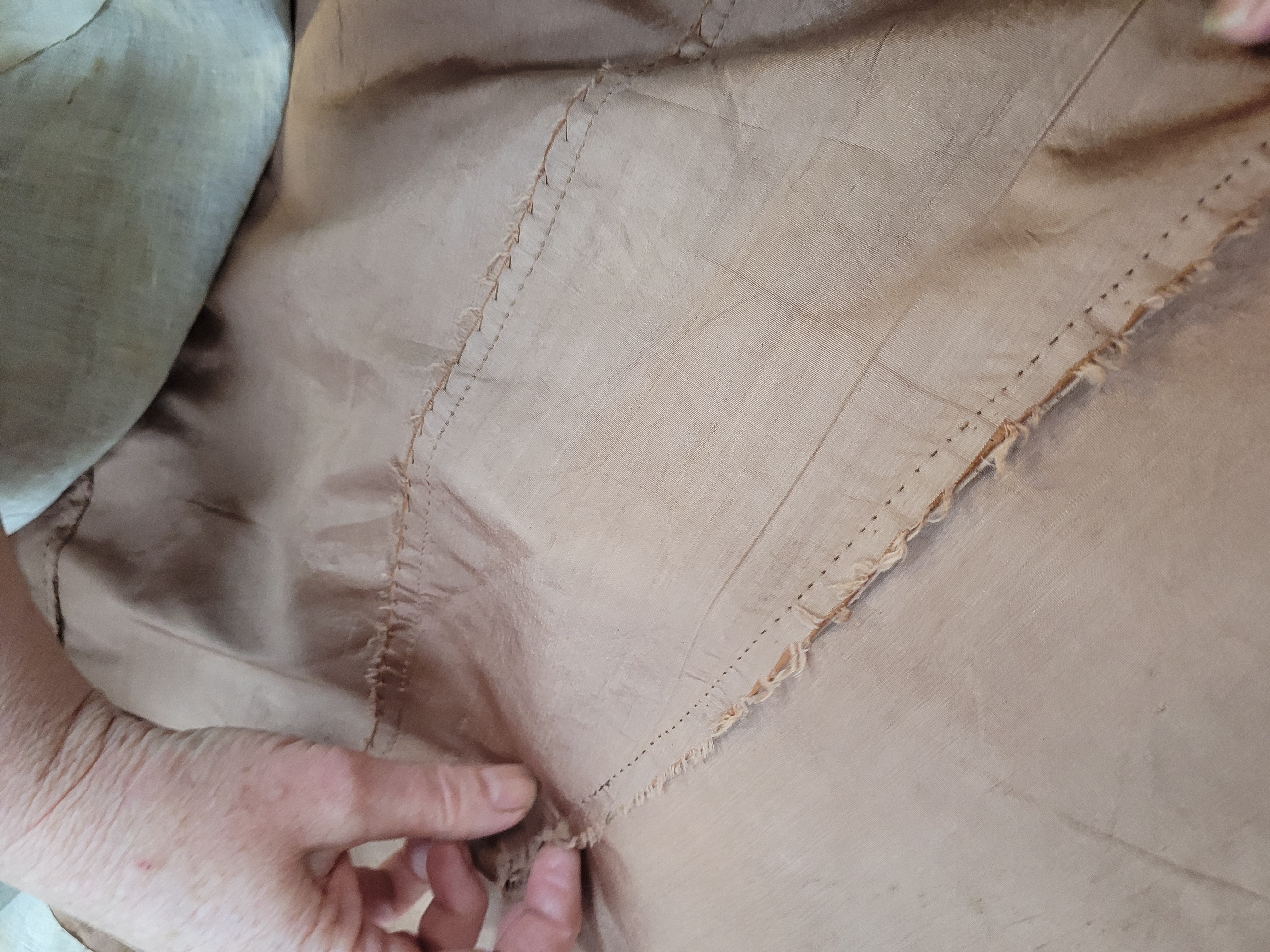
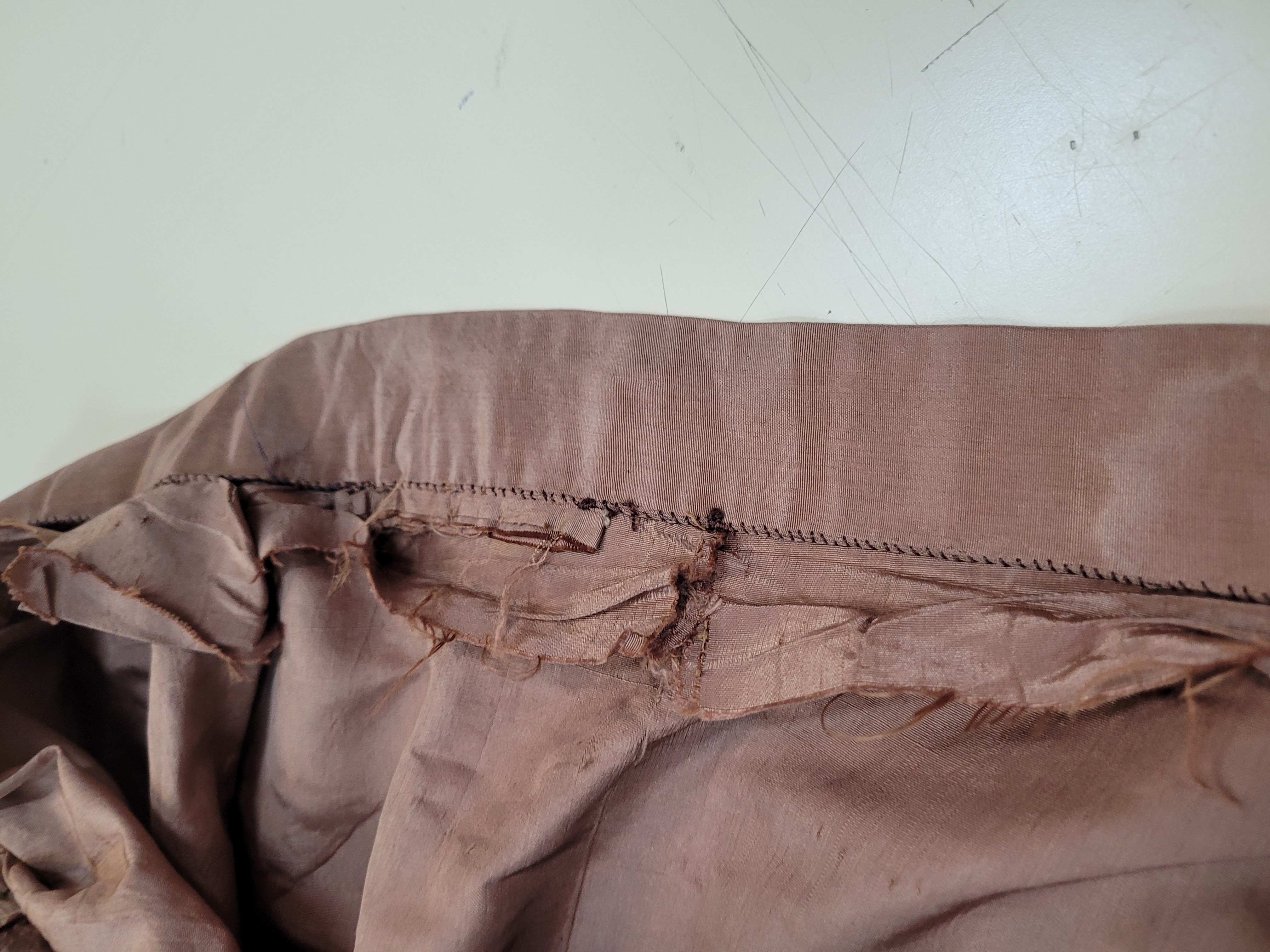
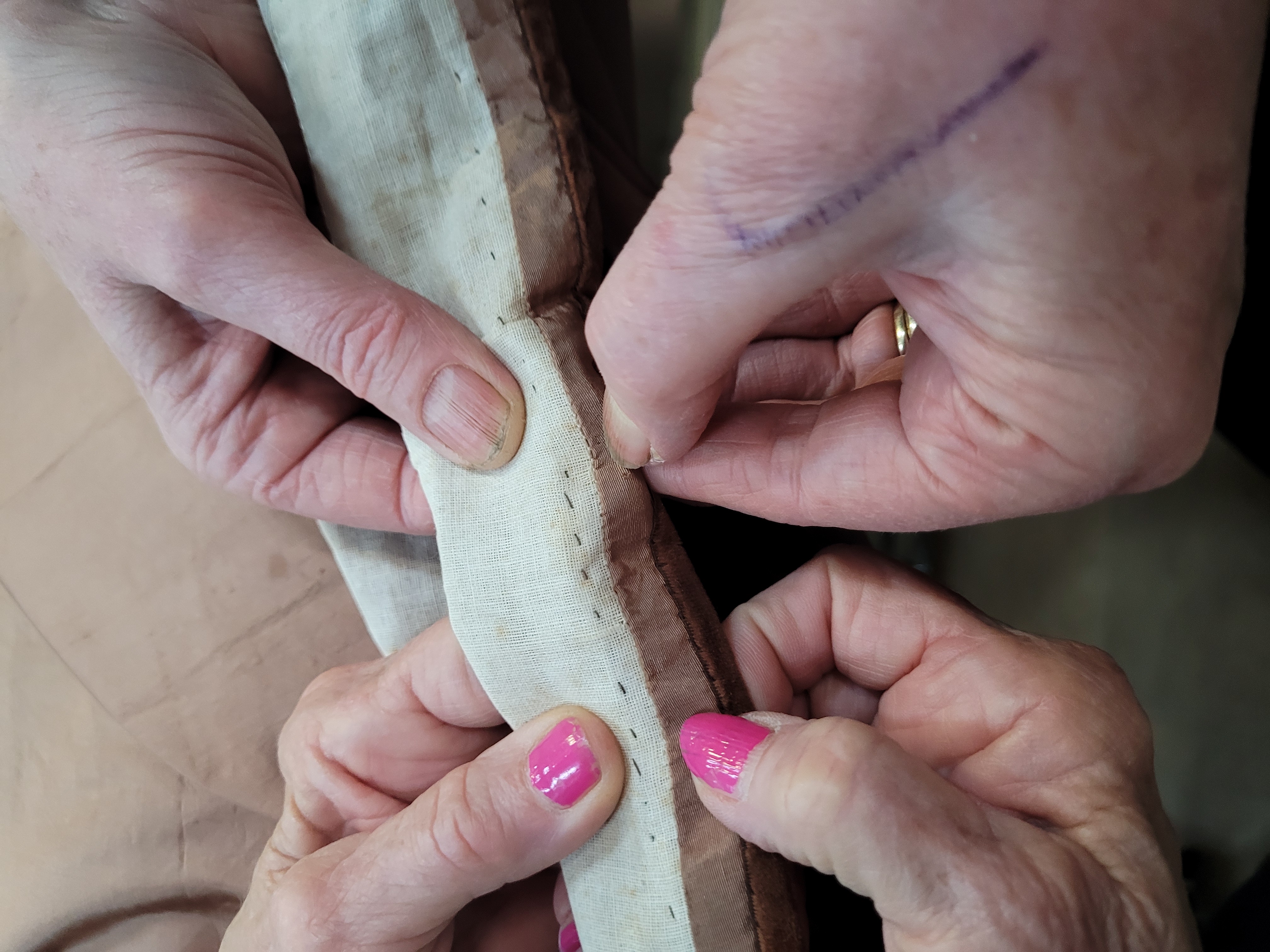
An examination of the skirt and bodice also revealed numerous alterations. One of the most striking alterations is the removal of the long sleeves, evident from the roughly cut fabric inside the shoulder sleeves. While the brown moiré (watered) silk is original to the gown, as are a number of features of the bodice such as the whale baleen and brass eyelets, the fabric removed from the waistline of the dress appears to have been used to expand the skirt pleats, and the bodice was taken out about 2 inches at a later point, possibly to fit a different wearer. Additionally, the lace fringing on the sleeves appears to be of the type normally used on window curtains!
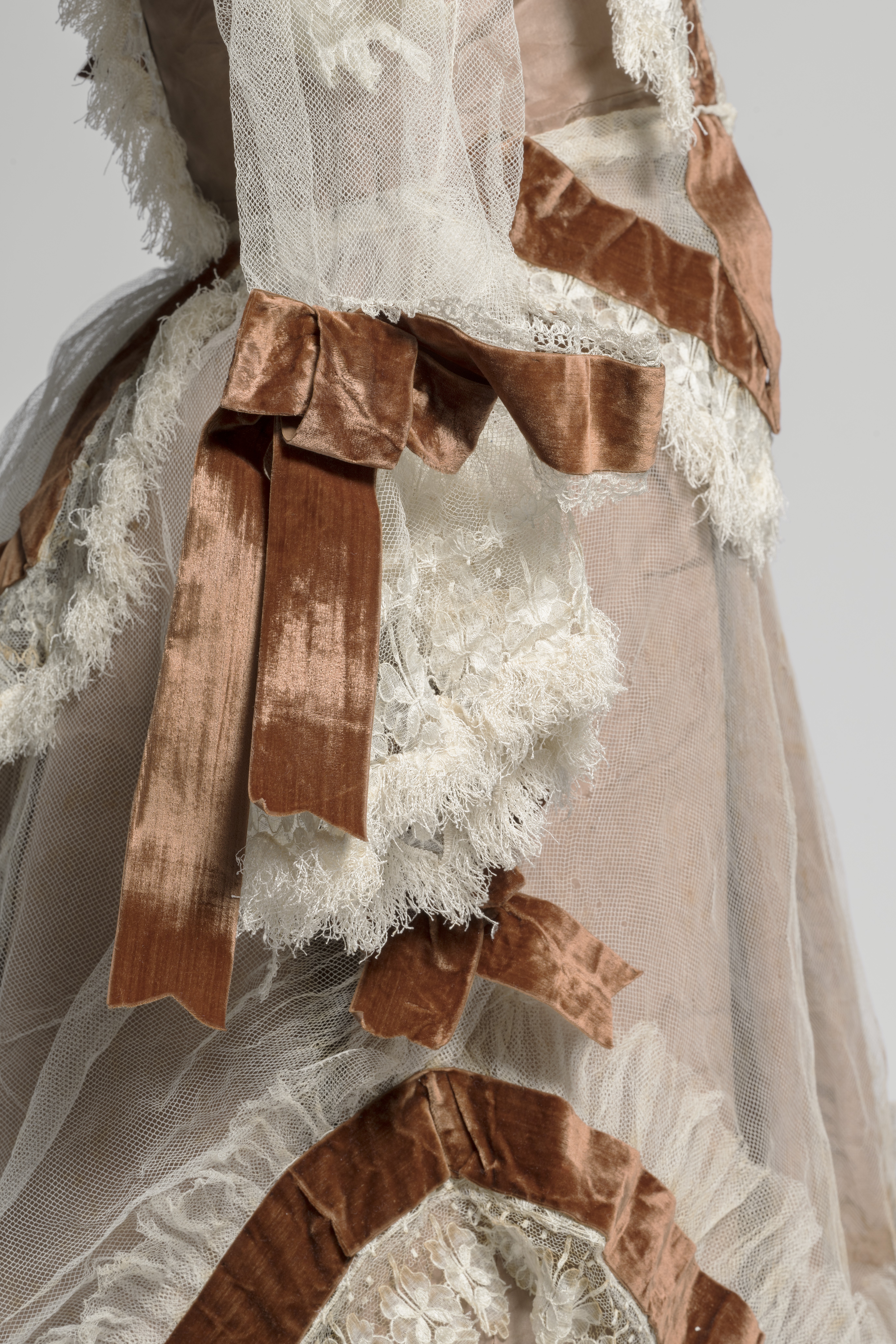
Pictured: detail of the sleeve fringing of Mary’s dress. Photo: Brenton McGeachie, 2025.
Whatever the case, the dress is an excellent example of the tradition of ‘mend and make-do’ or repurposing a piece of clothing many times after its original use.
Mary’s best dress
In the nineteenth century, wedding dresses were often re-worn by women as their ‘best dress’ after the wedding. It is likely that Mary wore the dress again after her wedding day, and the alterations to the bodice may reflect this. The later lace and velvet additions suggest that another family member altered the dress again in the twentieth century. Nevertheless, Mary’s dress has much in common with wedding dresses of the 1870s.
The brown colour of Mary’s dress meant it could be re-worn after the wedding day. White wedding dresses were popularised by Queen Victoria when she wore white silk to her wedding to Prince Albert in 1840; however, coloured wedding dresses continued to be common thereafter. The Powerhouse Museum holds Jane Frazer’s brown wedding dress c1880-1881, and notes that:
‘In this era many brides chose not to wear white dresses for economical and practical reasons. A coloured dress could be re-worn for formal occasions whereas white had limited use after the wedding day. Jane's dress is brown, a common choice of the time.’
Dresses in the 1870s were often well-embellished with flounces, bows, lace, tassels and so on, so the lace and velvet decoration on Mary’s dress is not out of keeping with the period either, but it does not appear to be original.
While little is known about the manufacture of Mary’s wedding dress and there are no known photographs of her wearing it, the original skirt and bodice are consistent with women’s fashions in the 1870s, including the watered silk which was popular in the nineteenth century for its luxurious shimmering effect. In the early 1870s it was common for women’s bodices to open at the front into a V-neck or square neckline as seen on Mary’s dress. Mary would have worn a chemise (shift dress) and drawers under the dress. There may have been a peplum (a small band of fabric) connecting the bodice and skirt of the dress, but if so, this has been lost. There would also have been some sort of bustle to support the voluminous skirts at the back of the dress.
The ‘dress improver’
Oscar Wilde once described fashion as ‘a form of ugliness so absolutely unbearable that we have to alter it every six months!’ Much has been said about the trends in bustles (also known as ‘dress improvers’) of the late nineteenth century, which underwent multiple transitions in the 1870s and 1880s and were routinely satirised in magazines for being impractical, unhealthy and ridiculous in appearance, before being discarded completely by 1905.
The 1870s was the beginning of the ‘bustle era’ for women’s dresses. A bustle was a device secured under the back of the dress to support skirts which were gathered at the back, projecting out below the waist and cascading downwards. The ‘first bustle’ style of the early 1870s was made for skirts which swept backwards but retained some of the volume of the rounder skirts of the 1860s.
At the time of Mary’s wedding in 1878, the popular dress shape for women in Europe and America was the slimline style known as the ‘natural form’ for the way it emphasised a woman’s figure and gathered the skirts closer to the hips. Popularised by Princess Alexandra – the wife of future King Edward VII of Great Britain – this style was also known as the ‘princess line’. The natural form soon gave way to the revival of the bustle (the ‘second bustle’ period) in the early 1880s, which returned to a more exaggerated form at the back of the dress but retained the slim figure and the frills, pleats and embellishments of the late 1870s style.
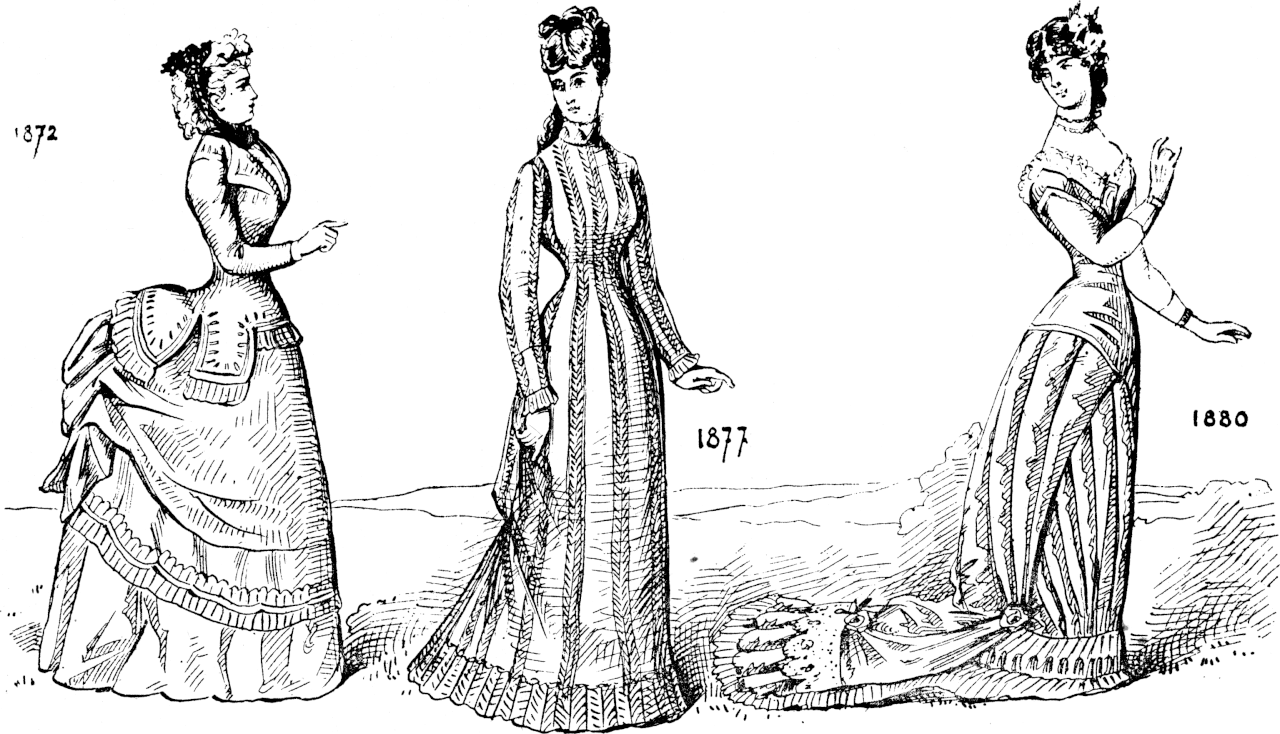
Pictured left to right: bustle style changes from the 1870s to the 1880s. On the left, the ‘first bustle’ with skirts projecting backwards and cascading down. In the centre, the ‘natural form’; on the right, the ‘second bustle’ of the 1880s. Source: Wikimedia commons https://commons.wikimedia.org/wiki/File:Modification_de_la_taile1872_1877_1880.gif
Mary’s dress best reflects the earlier style of the 1870s with a fuller skirt extending backwards and room at the back for a cascading bustle, although her skirt is relatively modest with minimal decorative elements. It is possible that the fashions of the UK, Europe and America took several years to be adopted in country Australia; however, it is just as likely that Mary’s modest nature as the daughter of Reverend Smith and her family’s modest income influenced the style of her gown.
Building a bustle
Preparing Mary’s dress for display required creating an historically accurate bustle form on a small budget. We spoke with historical dress consultants Liz Carlsund and Simone Finch, who recommended creating a small fabric bustle – a kind of dacron sausage – that could be tied around the back of a mannequin. Mary’s skirt has a side seam opening consistent with dresses of the period to allow for the addition and removal of a small bustle; however, when we tied a small cotton bustle to the mannequin, the skirts hung limply at the back, with too much fabric gathering in one place. It was clear a bigger bustle was needed.
Having no dressmakers or clothing historians on the CMAG team meant finding creative ways to build an historically accurate bustle shape to maintain the full volume of the skirts without attaching a wire or wooden-framed bustle device.
To recreate a bustle, we shaped nylon netting into a form which would hold up the skirts and allow them to taper into a short train at the back of the dress. The nylon was sewn onto a piece of conservation-grade cotton tying tape secured at the waist. On top of this we stitched pieces of calico which were reinforced with additional fabric at the back to create something like the ‘first bustle’ shape of the early 1870s.
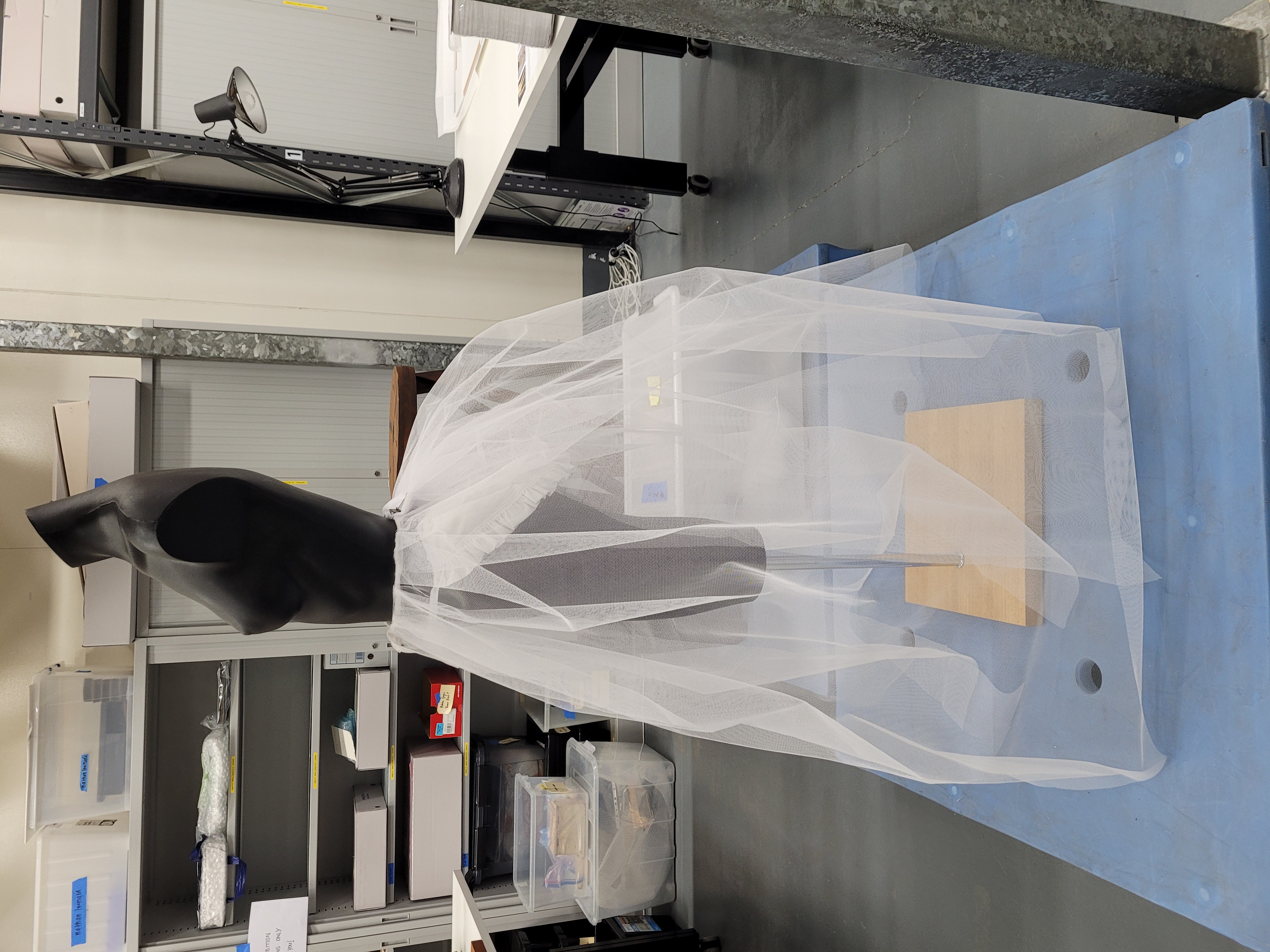
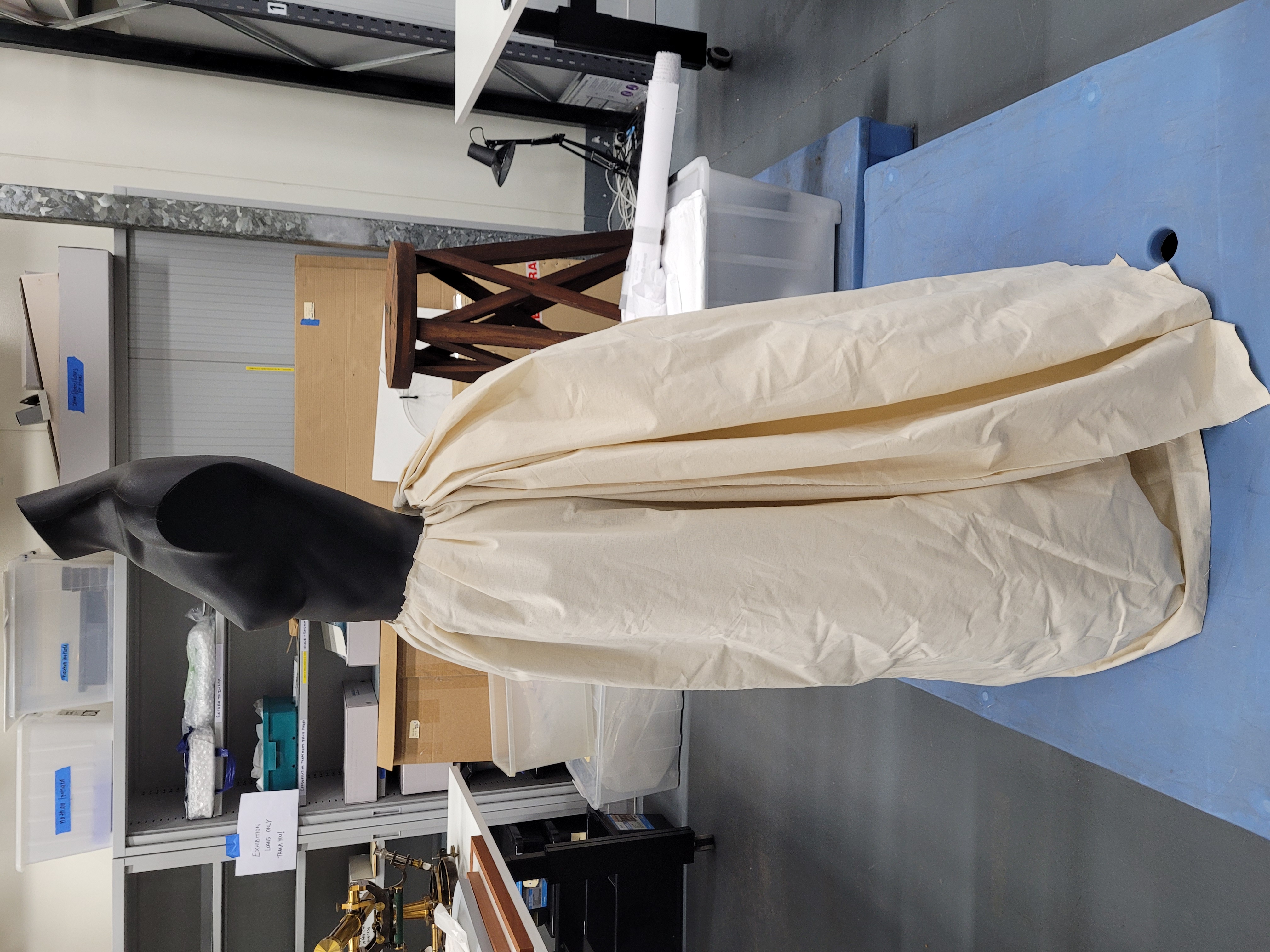
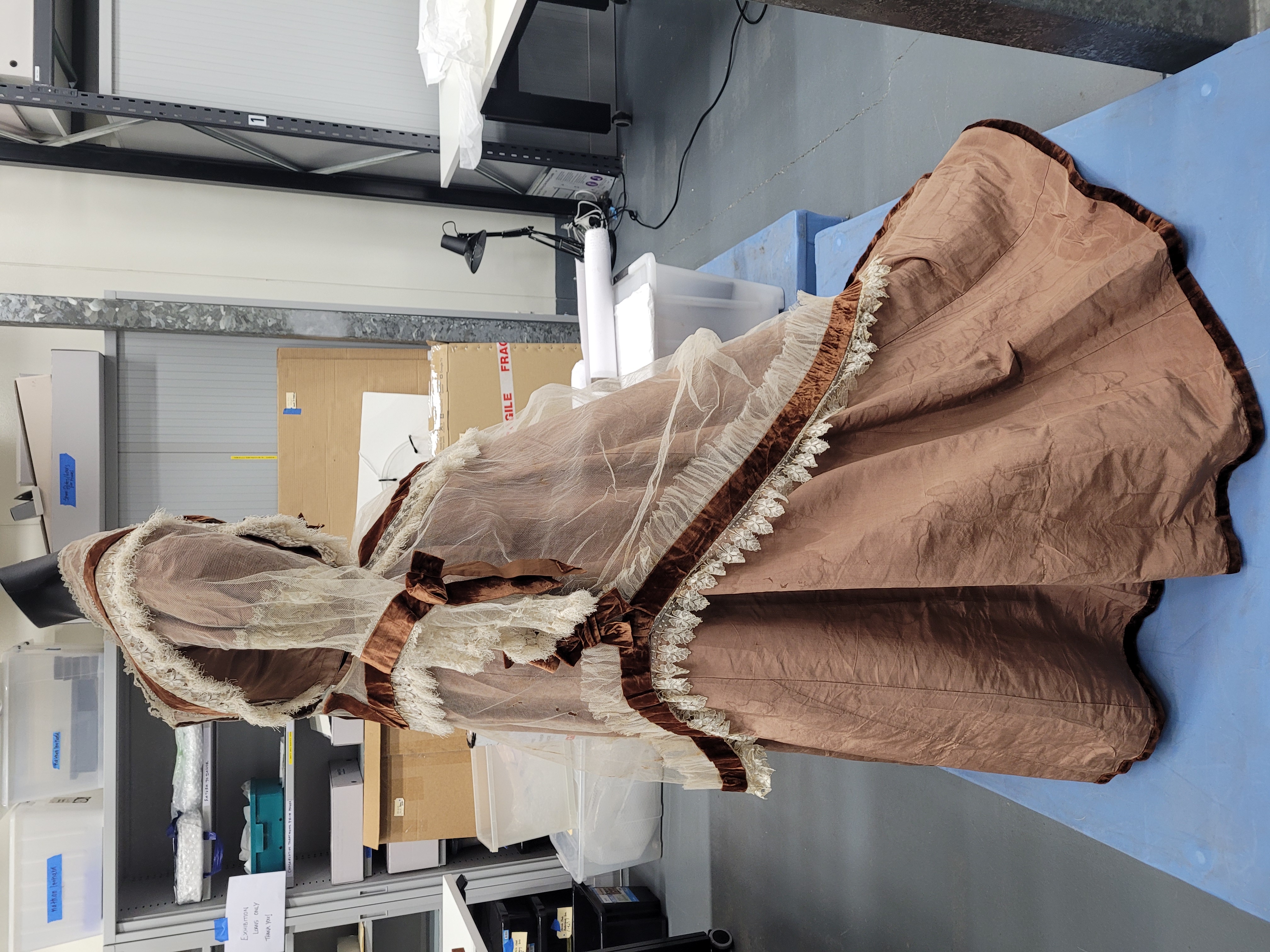
Finally, the skirts appeared to be sitting comfortably, giving the dress an appearance closer to that of an 1870s ‘first bustle’ skirt. Mary’s dress was installed in the exhibition Canberra/Kamberri: Place and People in October 2025.
The search continues …
More than 9 months of research, conservation and family consultation went into uncovering the layers of history behind Mary’s dress and preparing it for display. We still have much to learn about the dress and the lives of Mary, George and their children at Cuppacumbalong after 1878.
As much as we pride ourselves on our detective work as curators, we need your help. To date, we haven’t been able to locate a photograph of Mary and George on their wedding day. We’d love to see Mary in her original wedding dress, to confirm once and for all how it looked. If you think this elusive photograph exists, please contact us through our general enquiries email: cmag@act.gov.au
Acknowledgements: CMAG would like to thank the following De Salis family members for their assistance with this project: John de Salis for providing permission to access the De Salis family papers at the National Library of Australia; Steven Holland and Antony Fane de Salis for their time and insights about the family and the dress; and Paul Bradley for his input about the extended de Salis family.